
AI in Wellness Marketing: Why Human-Led Strategy Still Comes First
Artificial intelligence is rapidly changing how wellness brands create content, communicate with clients, and scale their visibility. From social media posts to blog post drafts and email sequences, AI tools promise speed, efficiency, and endless output.
But in wellness, content creation is not just marketing. It shapes trust. It influences health decisions. It reflects credibility, ethics, and professional authority. And without the right strategy behind it, AI can just as easily dilute a brand, misposition an expert, or quietly erode client trust.
At Beth Whiffen Communications, we work with wellness founders, physicians, and wellness coaches at every stage of growth. What we consistently see is this:
AI is not a strategy.
AI is an amplifier.
And what it amplifies depends entirely on the human expertise guiding it.
This guide explores how wellness professionals can use AI responsibly — and why human-led strategy must always come first.
The Real Content Challenge Wellness Coaches Face Today
Most wellness professionals did not build their practices to become full-time marketers. Yet today, visibility across blogs, email, Instagram, TikTok, LinkedIn, and podcasts is essential to growth.
Common challenges include:
Creating consistent content without burnout
Knowing what to say — and what not to say — in a regulated industry
Maintaining credibility while staying relevant
Aligning content with business goals, not just engagement
Protecting brand voice as teams scale
Many health coaches spend hours each week producing content with little clarity on what actually drives trust, authority, or conversion.
This is where AI can help — but only after strategy is clearly defined.
What AI Actually Does (and What It Does Not)
At its core, artificial intelligence analyzes patterns in large datasets and generates outputs based on prompts.
In marketing, this means AI-powered tools can assist with:
Drafting blog posts and captions
Generating content ideas
Structuring emails and educational material
Accelerating production workflows
What AI cannot do:
Define positioning
Understand scope of practice and compliance boundaries
Interpret clinical nuance
Build emotional resonance
Protect long-term brand equity
AI produces output. Humans create strategy.
In wellness, confusing the two is where brands get into trouble.
Why AI Is Riskier in Wellness Than in Other Industries
Unlike lifestyle or retail marketing, wellness content carries unique responsibility.
It intersects with:
Health claims and regulatory guidelines
Scope-of-practice boundaries
Mental and emotional vulnerability
Platform compliance (Meta, TikTok, YouTube)
Long-term professional credibility
Unsupervised AI use often leads to:
Overgeneralized health advice
Inaccurate or outdated claims
Tone that feels clinical, cold, or generic
Content that quietly violates platform policies
Erosion of trust with educated audiences
This is why in wellness, AI should never operate without experienced human oversight.
Why Human-Led Strategy Must Come Before AI
Before AI generates a single caption or blog draft, a wellness brand must clearly define:
Positioning and differentiation
Brand voice and authority markers
Target audience psychology
Scope of practice and compliance boundaries
Business objectives (growth, authority, conversion)
Platform-specific risk and opportunity
Without this foundation, AI tends to produce content that is:
Generic and interchangeable
Misaligned with expertise
Risky from a regulatory standpoint
Emotionally flat
Poorly positioned to convert
This is why the most effective wellness brands use AI inside a human-led strategic framework — not as a replacement for it.
At Beth Whiffen Communications, we begin with strategy first, then integrate AI as an execution layer that accelerates — rather than replaces — human intelligence.
Where AI Works Best in Wellness Marketing
When used intentionally and within clear strategic boundaries, AI can be a powerful tool.
1. Accelerating Execution Without Diluting Voice
AI helps teams move faster — generating drafts, outlines, and variations — while human experts refine tone, accuracy, and authority.
2. Supporting Consistency at Scale
AI-powered solutions enable consistent content publishing across different platforms without overwhelming founders or clinicians.
3. Enhancing Insight Through Data
AI-powered analytics tools can surface trends, engagement patterns, and monitor key metrics that inform smarter decisions.
Used correctly, AI does not replace expertise — it multiplies it.
How High-Performing Wellness Brands Actually Use AI
The most successful brands do not "hand content over to AI."
They use AI within a governed process:
Strategy defines positioning, audience, and objectives
Brand guidelines define voice and boundaries
Compliance frameworks define what cannot be said
AI accelerates drafting and iteration
Human experts review, refine, and approve
In practice, AI becomes:
A drafting assistant
A brainstorming partner
A production accelerator
Not:
A strategist
A clinician
A brand voice
A decision-maker
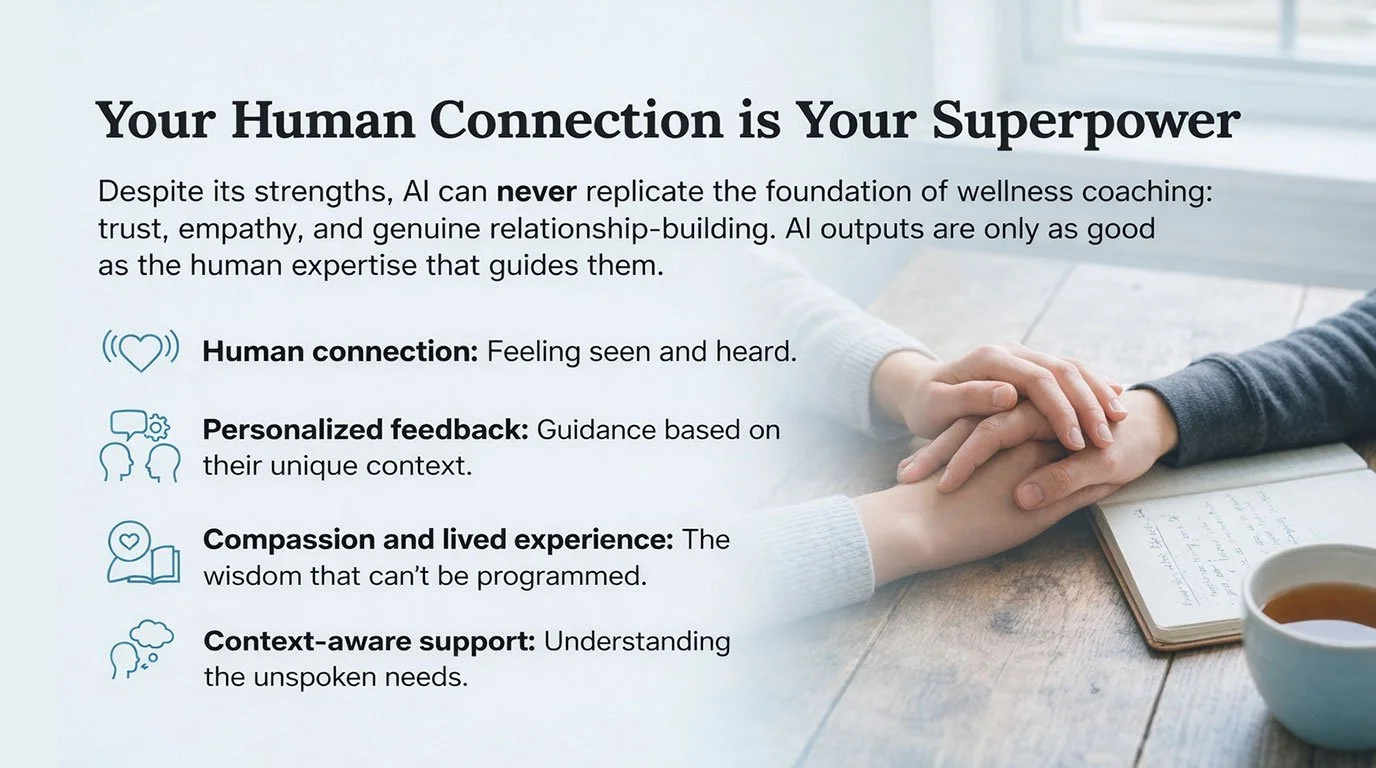
The Non-Negotiable Role of Human Connection
Wellness is built on trust.
Clients choose practitioners based on:
Credibility
Emotional safety
Lived experience
Professional judgment
Relational presence
No algorithm can replace:
Clinical intuition
Ethical discernment
Contextual understanding
Emotional intelligence
Therapeutic alliance
AI can support communication — but the human connection always remains central.
Ethical Boundaries When Using AI in Wellness
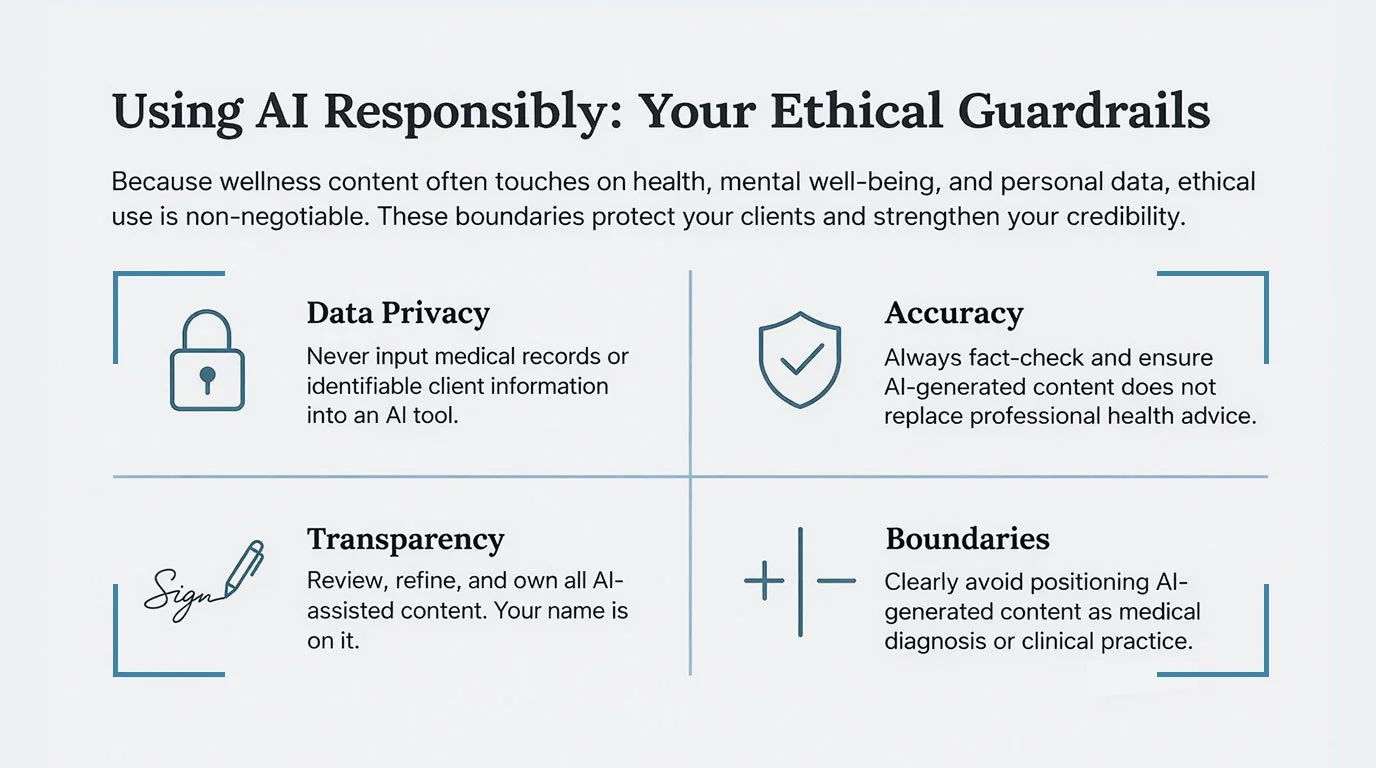
Because wellness content touches sensitive areas, ethical governance is essential.
Responsible use includes:
Never inputting identifiable client data
Reviewing all health-related outputs manually
Avoiding diagnostic or prescriptive language
Respecting scope-of-practice limits
Maintaining transparency and accountability
Ethical AI use strengthens credibility. Unsupervised AI use quietly undermines it.
Using AI to Support Sustainable Growth
When integrated thoughtfully, AI can help wellness brands:
Increase visibility without burnout
Maintain consistency across platforms
Improve internal workflows
Respond more efficiently to inquiries
Scale content without sacrificing quality
This allows founders and clinicians to focus on what matters most:
Client care, clinical excellence, and long-term impact.
Final Thoughts: Strategy First. Technology Second.
AI is not here to replace wellness professionals.
It is here to support them — when guided by experienced human intelligence.
In wellness marketing, the future belongs to brands that understand this balance:
Human-led strategy defines direction
AI accelerates execution
Human expertise protects credibility
Trust drives growth
Technology may evolve quickly. But in wellness, authority, ethics, and human connection will always remain the foundation.
Frequently Asked Questions (FAQs)
Are there ethical concerns when using AI in wellness marketing?
Yes, ethical concerns include data privacy, avoiding overgeneralized health advice, and respecting scope-of-practice boundaries. It is vital to review all AI outputs carefully and avoid inputting identifiable client data. Responsible use of AI strengthens credibility and protects clients’ mental well-being. Importantly, these ethical considerations highlight why a human-led strategy must guide AI use to ensure content is accurate, trustworthy, and aligned with professional standards.
Can AI improve client engagement and help attract new clients?
AI can enhance client engagement by generating motivational messages, personalized content, and scheduling social media posts that resonate with your target audience. However, the most effective engagement comes when AI-generated content is thoughtfully integrated within a human-led strategy, where wellness coaches apply their expertise to refine messaging and maintain authentic connections with both current and potential clients.
What role do machine learning and generative AI play in wellness marketing?
Machine learning enables AI tools to learn from data patterns, improving their accuracy in generating relevant content and personalized recommendations. Generative AI acts as a brainstorming partner, helping wellness coaches create fresh ideas and high-quality content. Yet, these technologies serve best as tools that support—not replace—the human insight, clinical judgment, and personal touch that define effective wellness marketing.
How can wellness coaches ensure data privacy when using AI tools?
Wellness coaches should use AI tools that comply with data privacy regulations, avoid sharing sensitive or identifiable client information, and maintain transparency about AI use. Prioritizing data privacy helps build trust and ensures ethical AI integration in the coaching business. A human-led approach is essential to oversee these safeguards and responsibly manage AI’s role in content creation.
What are some example prompts wellness coaches can use with AI to enhance their marketing?
Example prompts include: “Write a blog post about mental well-being tips for busy professionals,” or “Create a 3-slide carousel for fitness coaching targeting new moms.” These prompts help AI generate personalized content that supports wellness goals and client delivery. However, coaches should always review and tailor AI outputs to ensure alignment with their unique brand voice and human connection.
How can AI-generated content be optimized for different platforms in the fitness industry?
AI tools can tailor content length, tone, and format to suit platforms like Instagram, LinkedIn, or email newsletters. By analyzing engagement patterns, AI helps wellness coaches maintain consistent content that resonates with diverse audiences and supports growth in their fitness business. Despite this, human oversight remains crucial to preserve authenticity and ensure that messaging reflects the coach’s expertise and values.
What are the limitations of AI in wellness marketing?
AI cannot replace human expertise, clinical judgment, or emotional intelligence. It may produce inaccurate or generic content if not carefully supervised. Wellness coaches must always review AI outputs and ensure that their coaching practice maintains authenticity, credibility, and compliance with industry standards. This underscores the indispensable role of human-led strategy in guiding AI use responsibly.